


Persepolis
Vincent Paronnaud, Marjane Satrapi
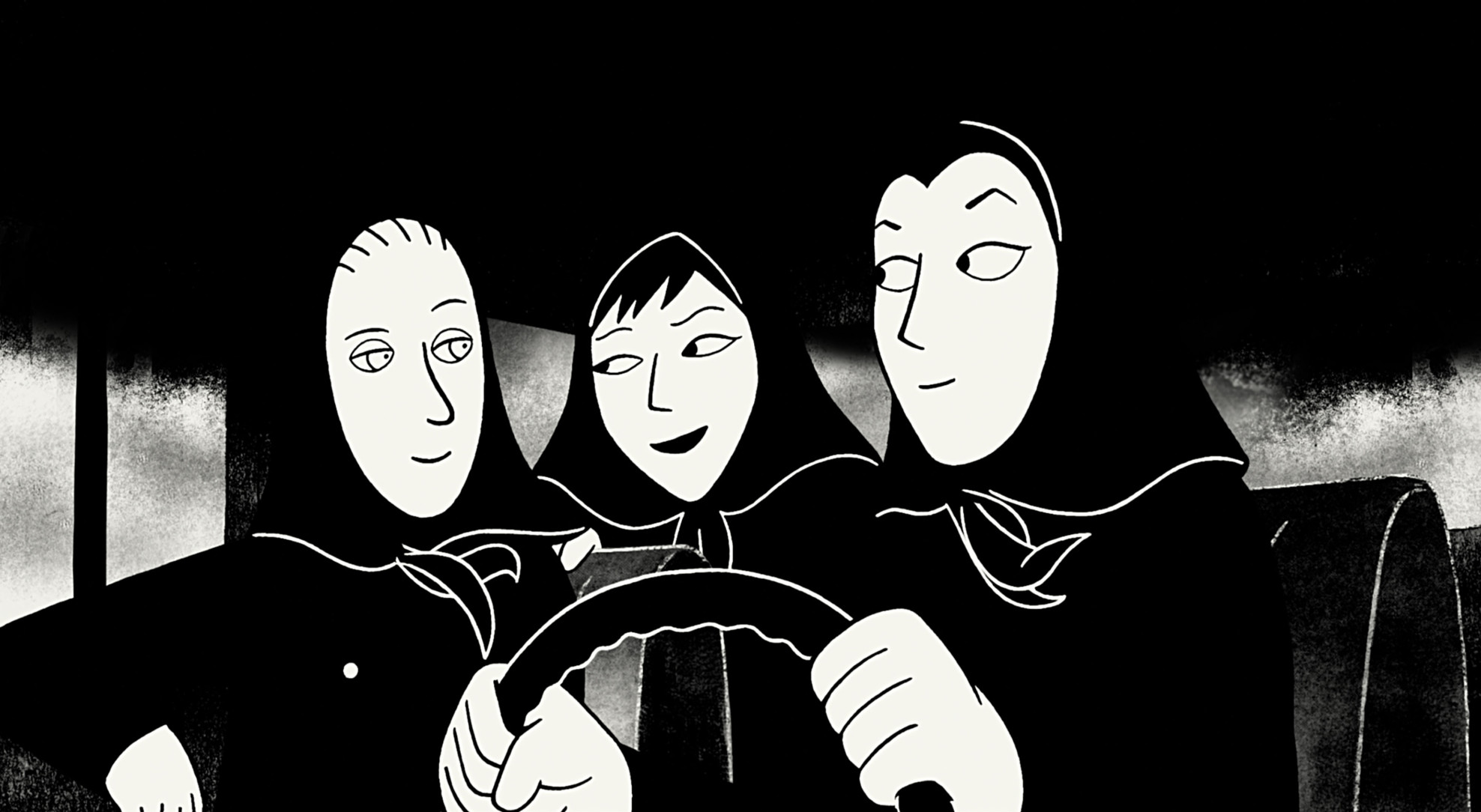
© StudioCanal
Tehran, 1978: eight-year-old Marjane thinks about the future and dreams of becoming a prophet who will save the world. Spoilt by her modern, cultured parents and particularly close to her grandmother, she follows with great excitement the events that will lead to the revolution and bring about the fall of the Shah’s regime. With the establishment of the Islamic Republic comes the era of the ‘Revolutionary Guard’, who control what people wear and how they behave. Marjane, who is now required to wear the hijab, dreams of becoming a revolutionary.
Cast : Chiara Mastroianni, Catherine Deneuve, Danielle Darrieux, Simon Abkarian
Scenario: Marjane Satrapi, Vincent Paronnaud
Sound: Sylvie Gourgner
Editing: François Nabos, Stéphane Roche
Music: Olivier Bernet
Scenario: Marjane Satrapi, Vincent Paronnaud
Sound: Sylvie Gourgner
Editing: François Nabos, Stéphane Roche
Music: Olivier Bernet
Production : 2.4.7. Films
Distribution : StudioCanal
Distribution : StudioCanal
Screened in the Official Selection at Cannes in 2007, Persepolis walked away with a well-deserved Jury Prize. One might even have hoped for more from this original work, which is extraordinarily rich in its visuals, themes and emotion. An adaptation of Marjane Satrapi’s eponymous graphic novel, the film explores Iran’s recent history through the eyes of Marjane herself, who draws on her own life to express her love for her country and its people. Focusing on a few members of her family and, even more so, on her own feelings, the young woman, in collaboration with Vincent Paronnaud, nonetheless delivers a timeless and universal piece. First and foremost, in its portrayal of a dictatorial regime. There is no doubt about it: you can’t to recognise Iran, with the women forced to go out veiled, the constant threat from the state, represented by the Revolutionary Guard… Yet you can sense that similar events could just as easily unfold in Fascist Italy or in present-day China. There is also a visual universality, for whilst Marjane Satrapi possesses a highly expressive and individual graphic style, she draws on all manner of sources to enrich her artwork. The expressionism of Munch, Otto Dix and, more subtly, Murnau, is evident; you can detect references to Japanese woodblock prints, whilst the way the scenes are sketched out is reminiscent of Italian neorealism… The work is, therefore, universal."" (Marie Bernard; avoir-alire.com)