


2001: A Space Odysse
Stanley Kubrick
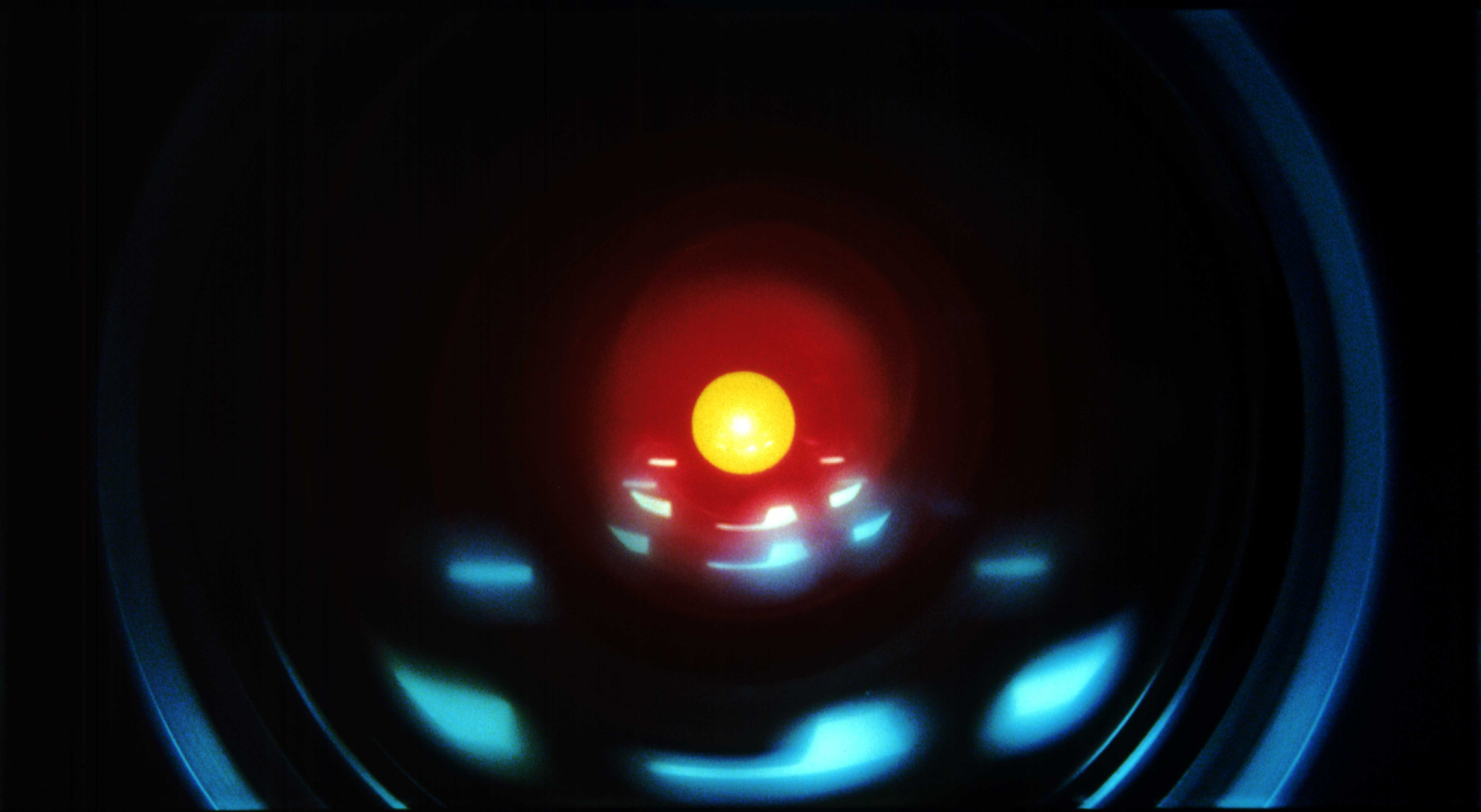
© Park Circus, Warner Bros
Prehistoric primates, having discovered a black monolith, develop tools and superior intelligence. Millions of years later, in 2001, Dr Heywood Floyd is investigating a monolith buried on the Moon, which is transmitting a signal to Jupiter. To investigate this mystery, the spacecraft Discovery One is sent to Jupiter with astronauts David Bowman and Frank Poole on board, assisted by the computer HAL 9000.
Cast : Keir Dullea, Gary Lockwood, William Sylvester, Daniel Richter
Scenario: Stanley Kubrick, Arthur C. Clarke
Cinematography: Geoffrey Unsworth
Editing: Ray Lovejoy
Scenario: Stanley Kubrick, Arthur C. Clarke
Cinematography: Geoffrey Unsworth
Editing: Ray Lovejoy
Production : Metro-Goldwyn-Mayer (MGM), Stanley Kubrick Production
Distribution : Park Circus
Distribution : Park Circus
What strikes you immediately when you watch 2001: A Space Odyssey again today is just how little, if at all, this hugely important and admired film has influenced the history of cinema. And whilst it may have openly inspired certain works, from Dunkirk to The Tree of Life, which themselves are seen as out of the ordinary films – though far removed from the strangeness of Stanley Kubrick’s film – this only serves to highlight the divide between it and Hollywood cinema, which, deep down, has never really stopped shunning it. So this film, which laid the foundations for the ‘blockbusters’ that emerged some ten years later, seems to be their aesthetic antithesis: no hero or anti-hero, a fragmented structure, empty frames, obscure stakes and dialogue reduced to a minimum (whereas American cinema is the most verbose of all). It is perhaps for this reason, furthermore, that fifty years after its theatrical release, it still seems so fresh, innovative and incredibly surprising. Because cinema has never got used to its narrative ambition, nor has it been able to come to terms with its formal innovations. Never has such a fundamental film been so little imitated, save for a few special effects techniques and some other motifs. By retreating towards neo-classicism as early as the 1970s, American cinema has left 2001 with exclusive rights to its genius, the privilege of its grandeur, and the monopoly on the lead it had over its time – and which it still holds today. It is destined to retain its beauty intact, untouched by any reappropriation. A film the likes of which had never been seen before and will never be seen again. A film whose power you rediscover with astonishment at every new viewing, since no one has been able to distort its essence. A film that is utterly inexhaustible."" (Matthieu Santelli; critikat.com)