


The Marquise of O...
La Marquise d'O...
Eric Rohmer
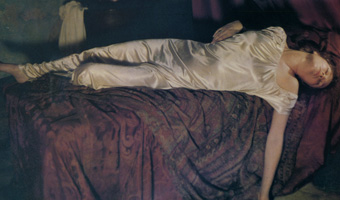
During the taking of a fortress in Lombardy in 1799 by Russian troops, a young widow, the marquise d'O... is saved from dishonour by an enemy army officer. Some time later, she discovers that she is pregnant, without knowing by whom. Repudiated by her family, she decides to place an announcement in a newspaper to find out who the father is...
With : Edith Clever, Bruno Ganz, Peter Luhr, Edda Seipel, Otto Sander, Ruth Drexel, Eduard Linkers, Eric Rohmer
Screenplay : Eric Rohmer (d'après l'œuvre d'Heinrich von Kleist)
Image : Nestor Almendros
Sound : Jean-Pierre Ruh
Editing : Cécile Decugis
Decors : Rol Kaden, Helo Gutschwager
Costume : Moidele Bickel
Mixage : Alex Pront
Music : Guy Robert d'après des airs des XII et XIII siècles
Screenplay : Eric Rohmer (d'après l'œuvre d'Heinrich von Kleist)
Image : Nestor Almendros
Sound : Jean-Pierre Ruh
Editing : Cécile Decugis
Decors : Rol Kaden, Helo Gutschwager
Costume : Moidele Bickel
Mixage : Alex Pront
Music : Guy Robert d'après des airs des XII et XIII siècles
Production : Les Films du Losange, Janus Film, Fernse-Produktion GmbH
Distribution: Les Films du Losange
Distribution: Les Films du Losange
When Eric Rohmer went to Berlin to find the count for La Marquise d'O and asked who the best stage was he was taken to see Bruno Ganz. Rohmer spoke in German to direct his actors, who came from the theatre, mostly from Peter Stein's Berlin company. Rohmer's main demand was to have Kleist's text heard in full. He made his actors articulate even more and slowed down their rhythm in relation to work on stage. "I tried to find the natural of the time: a natural which, of course, appears to use to be empathic, full of eloquence. I didn't want to see the period from the point of view of a filmmaker who had been in a time machine, but rather film in the way somebody of the period would have filmed if cinema had existed. And paintings give us clues about the attitudes of the time" (Eric Rohmer).
"I carried the book with me while making this film since it was easier to put in my pocket than a scenario!". One cannot so much call "La Marquise d'O..." an adaptation of Heinrich von Kleist's novella as a theatrical staging. Constructed around a crucial ellipsis - what follows diegetically the famous shot of the Marquise lying there feverish - this film is filled with latent erotism. References to paintings by Füssli, Greuze, Friedrich, Goya and Fragonard recur but this quest for the aesthetic strives for realism. On that count, the body language of the actors Edith Clever and Bruno Ganz is remarkable. Both the historical era and its context "exist" with simplicity. The frame surrounding this reconstruction fades away. The Marquise first learns to her expense and finally with joy angels and demons go hand in hand: this is the superb irony of Kleit's magical tale. Special Jury award at the Cannes Festival in 1976
Catalogue Premiers Plans 1997