


Nosferatu, Eine Symphonie Des Grauens
Friedrich Wilhelm Murnau
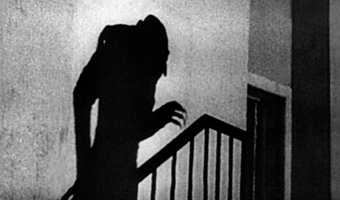
In 1838, Hutter, a young solicitor's clerk, goes to have a contract signed by the lord of a castle in Transylvania. He leaves his young wife, Ellen, in Wisborg. On the way he encounters threatening people and forebodings of evil. He nevertheless arrives at the castle, where he is welcomed by Count Orlok. But on the very first night, Orlok reveals his true identity: he is the reincarnation of the vampire Nosferatu. Hutter is horrified and hastily returns to Wisborg. But Nosferatu has got there before him, leaving terror and plague in his wake...
With : Max Schreck, Gustav von Wangenheim, Greta Schröder, Alexander Granach, Georg H. Schnell, Ruth Landshoff
Screenplay : Henrik Galeen (d'après le roman Dracula de Bram Stoker)
Image : Fritz Arno Wagner
Decors : Albin Grau
Screenplay : Henrik Galeen (d'après le roman Dracula de Bram Stoker)
Image : Fritz Arno Wagner
Decors : Albin Grau
Production : Prana Film GmbH
Distribution: Les Films sans Frontières
Distribution: Les Films sans Frontières
In 1921, Albin Grau, the founder of Prana-Film, and a keen occultist, suggested to Murnau that he should film Nosferatu. The film ruined its producer because of the adaptation rights, but enabled Murnau to break with the expressionist movement by choosing to film in natural settings. Murnau laid down the cinematographic foundations of the myth of Dracula. "In the history of cinema, Frankenstein's family tree begins with Der Golem (The Golem) (1915), Dracula's with Nosferatu" (N. Andrews). With its haunted castle, the port where the rats land, the village and the monster himself, played by Max Schreck with his bald head and vampire teeth, some saw in Nosferatu a work foreshadowing the rise of Hitler.