


Léon Morin, prêtre
Jean-Pierre Melville
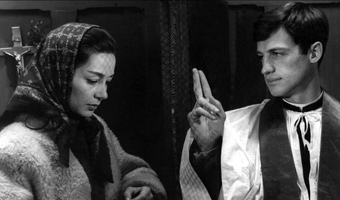
During the Occupation, Barny, the young widow of a communist Jew, decides to go into a confessional on a sudden whim and states that she finds religion ridiculous, even perfidious. Fr Léon Morin responds calmly to the attacks, hears her confession and absolves her. He then suggests that she should come and get some books from his house. Little by little, conversion begins...
With : Jean-Paul Belmondo, Emmanuelle Riva, Irène Tunc, Nicole Mirel
Screenplay : Jean-Pierre Melville (d'après le roman éponyme de Béatrice Beck)
Image : Henri Decaë
Sound : Guy Villette
Editing : Jacqueline Meppiel, Nadine Marquand, Marie-Josephe Yoyotte, Denise de Casabianca, Agnès Guillemot
Decors : Daniel Guéret
Music : Martial Solal, Albert Rasiner
Screenplay : Jean-Pierre Melville (d'après le roman éponyme de Béatrice Beck)
Image : Henri Decaë
Sound : Guy Villette
Editing : Jacqueline Meppiel, Nadine Marquand, Marie-Josephe Yoyotte, Denise de Casabianca, Agnès Guillemot
Decors : Daniel Guéret
Music : Martial Solal, Albert Rasiner
Production : Rome-Paris-Films, Compagnia Cinematografica Champion
Distribution: Tamasa Distribution
Distribution: Tamasa Distribution
This is Melville's first film with a star, Jean-Paul Belmondo, with whom he would go on to make three films. They met on the shoot of Vittorio de Sica's Ciociara (Two Women), and Jean-Paul Belmondo was initially hostile to the project until Melville convinced him to play a role against type. Léon Morin, prêtre, "breaks down the borders of anecdote, loses its restrictive religious character, and achieves, in the simplest, most honest, and therefore most difficult way, a universal dimension" (Claude Sautet). "What attracted me Béatrice Beck's book, that I had wanted to adapt since it was published in 1952, was the character of Léon Morin because of the non-autobiographical way of telling what is personal, I think, to all creators, because if I had been a priest I would have reacted like him... In everything he does, a director must be able to disguise himself in a costume of the same colour as the story he is telling" (J-P Melville).