


La Vita è Bella
Roberto Benigni
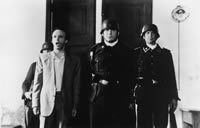
Italy, 1938. Guido, a young whimsical waiter, is in love with Dora, the village schoolteacher. Promised to a Fascist bureaucrat, he kidnaps her the day of her engagement. Five years later, their son Giosué is born, just as the Mussolini government takes up the Nazi anti-Semitic policy. Guido, a Jew, is stopped then deported with his son to a concentration camp. Dora, a Catholic, boards the train with them. Once inside the camp, Guido decides to hide the horror of the extermination from his son and persuades him that their "concentration camp stay" is a game.
Screenplay : Roberto Benigni, Vincenzo Cerami
Image : Tonino Delli Colli
Sound : Tullio Morganti
Music : Nicola Piovani
Editing : Simona Paggi
Distribution: Bac Films
Trained in the circus in his youth then in the techniques of the "one-man show" and television, Roberto Benigni, actor and filmmaker (You Upset Me, 1983, The Monster, 1994) takes his inspiration from the "Commedia dell'Arte" and American burlesque traditions. Inspired by a Primo Levi phrase [And if it were all a joke? All this cannot be real...], Life is Beautiful, Grand Jury prize at Cannes and Best Foreign Film at the Oscars, brought him international recognition. "We imagined Guido's character embodying innocence. Innocence from a physical point of view: even in his body he's anti-Fascist. He's the exact opposite of the Fascist icon, that adulation of marble and muscle. And we wondered what would happen, almost chemically speaking, if we threw that innocence into utter darkness." (Vincenzo Cerami, co-writer)